
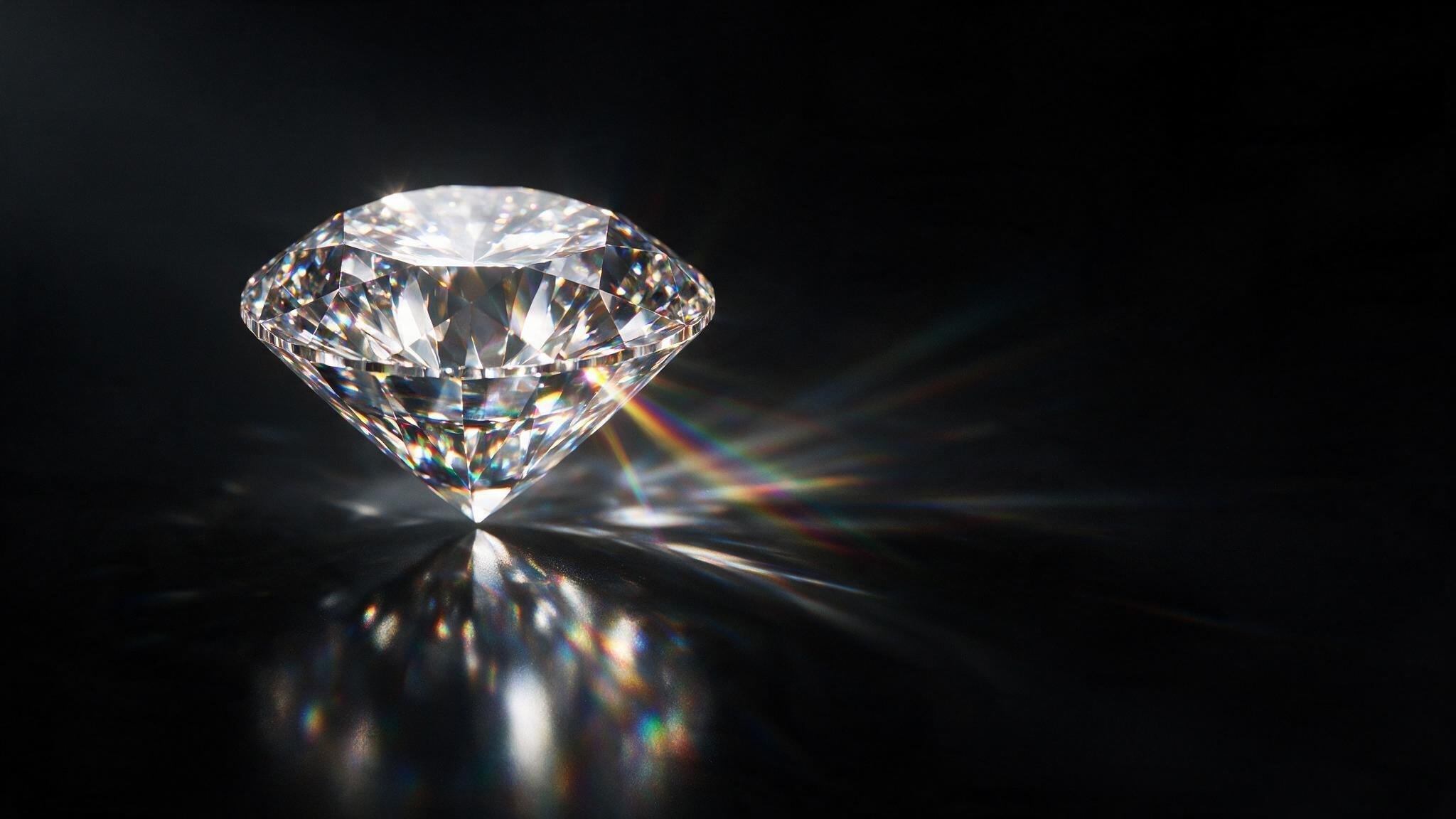
Diamond Education
Lab-Grown vs. Natural Diamonds: Which Should You Choose?
Same chemistry, same sparkle, very different origin stories — here's how to decide which one is right for your piece.

Ask a gemologist to tell a lab-grown diamond apart from a natural one with the naked eye, and they can't — not because the difference doesn't exist, but because there isn't one to see. Both are, chemically and optically, 100% real diamond. The only difference is where they came from and how long it took to get here.
Because every Seventyninth Avenue piece is made to order, you choose between natural and lab-grown for every stone we set — it's not an upsell, it's a real decision with real trade-offs. Here's what actually separates them.
At a Glance
Lab-Grown vs. Natural, Side by Side
| Factor | Natural Diamond | Lab-Grown Diamond |
|---|---|---|
| Chemical composition | Pure carbon crystal | Pure carbon crystal — identical |
| Hardness (Mohs scale) | 10 | 10 — identical |
| Formation | Earth's mantle, 1–3 billion years | Laboratory (HPHT/CVD), 6–10 weeks |
| Grading standard | GIA 4 C's | Same 4 C's scale — GIA or IGI |
| Price per carat | Baseline | Typically 60–75% less |
| Rarity | Finite, geologically limited | Unlimited, produced on demand |
| Resale value | Holds value more predictably | Currently declining as production scales |
| Certification | GIA — the traditional standard | IGI — the lab-grown industry standard; GIA also available |
| Visible to the naked eye? | Indistinguishable without lab equipment | Indistinguishable without lab equipment |
| Best for | Rarity, heirlooms, long-term value | Maximum size or quality per budget |
Origin
Same Stone, Different Origin
A natural diamond forms roughly 90 to 120 miles below the earth's surface, where extreme heat (around 2,200°F) and pressure (over 725,000 pounds per square inch) compress pure carbon into a crystal lattice over one to three billion years. Volcanic eruptions eventually carry them close enough to the surface to be mined.
A lab-grown diamond starts with a tiny sliver of existing diamond, called a seed, and grows it under one of two processes: HPHT (High Pressure, High Temperature) recreates the same conditions found deep in the earth, compressed into a matter of weeks instead of a billion years. CVD (Chemical Vapor Deposition) grows a diamond atom by atom inside a vacuum chamber filled with carbon-rich gas, building the crystal up layer by layer.
Both processes result in the exact same crystal structure as a natural diamond — carbon atoms arranged in the same cubic lattice. There's no shortcut, no different mineral, no synthetic substitute involved. It's diamond, built on a different timeline.
How a diamond forms — natural vs. lab-grown
Detection
Can You Tell Them Apart?
Not with your eyes, and not with a standard jeweler's loupe. Lab-grown and natural diamonds share the same hardness (10 on the Mohs scale), the same refractive index, and the same fire and brilliance. They're graded on the exact same 4 C's scale, by the same labs.
The only reliable way to tell them apart is specialized equipment that detects trace growth patterns invisible to the eye — equipment most jewelry stores don't own. Every diamond we set, natural or lab-grown, comes with grading documentation that discloses exactly what it is, so you always know precisely what you're getting.
The Real Differences
Where They Actually Differ
Price
This is the biggest practical difference, and it has widened significantly in recent years as lab-grown production has scaled globally. A lab-grown diamond now typically costs 60–75% less than a natural diamond of the same size and grade, because growing a diamond in weeks is simply cheaper than the geological process — and the search, mining, and sorting — required to find and extract one. That gap tends to be largest at 1 carat and above.
Typical price gap at matching specifications
Rarity & Resale
Natural diamonds are a finite geological resource — every one mined is one fewer in the ground. Lab-grown diamonds can be produced on demand, and production volume has grown quickly, which has pushed lab-grown prices down year over year and made resale value a real consideration: lab-grown stones currently hold their value less predictably on the resale market than natural ones. If long-term value retention matters to you, that's worth factoring in.
Environmental & Sourcing Considerations
Lab-grown diamonds avoid the environmental footprint of mining, though the growing process is energy-intensive in its own way. Natural diamonds sold today are overwhelmingly sourced through the Kimberley Process, a certification system designed to keep conflict diamonds out of the legitimate market. Both are legitimate, traceable choices — the right one depends on what matters most to you.
Putting It Together
Which Should You Choose?
- Choosing by size or budget? Lab-grown lets you go noticeably bigger, or a full grade or two higher on cut, color, and clarity, for the same money.
- Care about rarity or long-term resale value? Natural diamonds are the traditional choice for a reason, and they tend to hold value more predictably.
- Either way, insist on grading documentation. GIA and IGI both certify natural and lab-grown stones — ask to see it before you buy anywhere, not just from us.
FAQ
Frequently Asked Questions
Can you tell a lab-grown diamond apart from a natural one?
Not with the naked eye or a standard jeweler's loupe. Both share identical chemistry, hardness, and brilliance — telling them apart requires specialized lab equipment that detects trace growth patterns.
Are lab-grown diamonds real diamonds?
Yes. A lab-grown diamond is chemically, physically, and optically identical to a natural diamond — pure carbon in the same crystal structure. The only difference is where and how quickly it formed.
Why are lab-grown diamonds cheaper than natural diamonds?
Growing a diamond in a lab over weeks is simply less costly than the geological process, plus the searching, mining, and sorting required to find and extract a natural one — lab-grown typically runs 60–75% less per carat at the same size and grade.
Do lab-grown diamonds hold their value?
Currently, lab-grown diamonds hold resale value less predictably than natural diamonds, as production volume has scaled and prices have declined year over year. Natural diamonds, being a finite resource, tend to retain value more predictably.
Is a lab-grown diamond certified the same way as a natural one?
Yes, both are graded on the same 4 C's scale. Natural diamonds are traditionally certified by GIA; lab-grown diamonds are most often certified by IGI, though GIA certifies lab-grown stones as well — by law, a lab-grown diamond's origin must always be disclosed.
Choosing Between Natural and Lab-Grown at Seventyninth Avenue
Every setting we make is available with either a natural or lab-grown center stone, sourced to your exact specifications on cut, color, clarity, and carat. Not sure which fits your budget and priorities? Tell us what matters most, and we'll walk you through real options side by side before anything is set.
Start Your Custom PieceDiamond grading standards referenced are those of the Gemological Institute of America (GIA). Diagrams are illustrative and simplified for education.
