Diamond Education
The 4 C's of Diamonds: A Complete Guide to Cut, Color, Clarity & Carat
Everything worth knowing before you choose a stone — explained simply, illustrated clearly, and framed around how we actually build your piece.

Every diamond is graded on four characteristics that, together, determine how it looks and what it's worth: Cut, Color, Clarity, and Carat weight. The system was developed by the Gemological Institute of America (GIA) in the 1940s so diamonds could be compared on a consistent, objective standard — no matter where they were cut or sold.
Because every Seventyninth Avenue piece is made to order, we don't hand you a display case to pick from — we source and set a diamond to your exact specifications on the 4 C's once you've chosen a setting. Understanding what each one means isn't just background reading here; it's how you'll actually make decisions about your piece. Here's the full picture.
1Cut
Cut — The Diamond's Sparkle
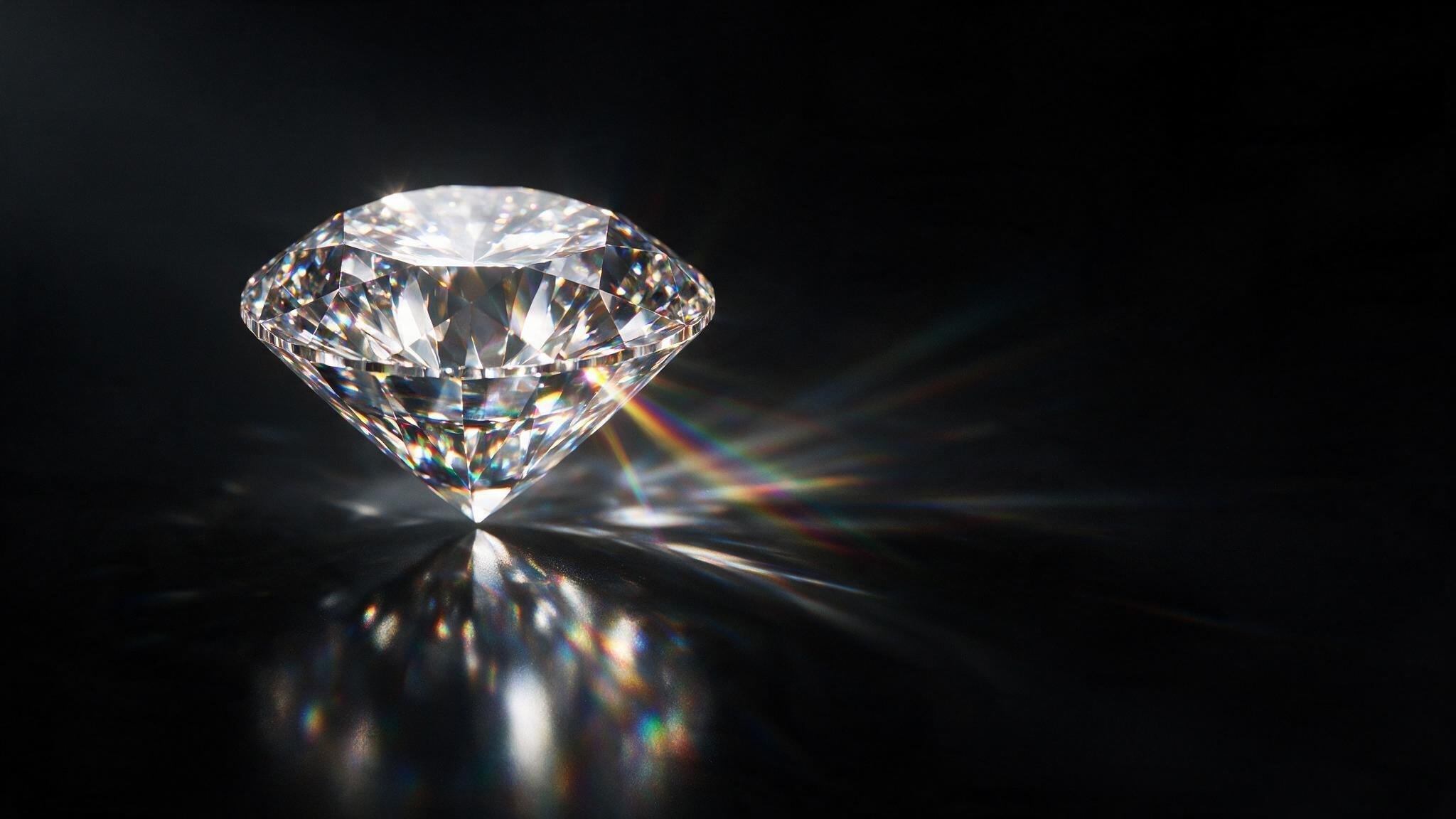
Cut is the most important of the 4 C's, for one simple reason: it controls how much light actually comes back out of the stone. A diamond is faceted from rough crystal into a precise arrangement of flat surfaces — a modern round brilliant has 57 or 58 of them — and the angles, proportions, and symmetry of those facets decide whether light entering the top bounces back up to your eye, or leaks out through the bottom and sides where you'll never see it.
Anatomy of a diamond — round brilliant cross-section
Understanding the anatomy makes the grading make sense: light enters through the table, the large flat top facet, and travels down through the crown. It reaches the pavilion — the cone-shaped lower two-thirds beneath the girdle (the thin edge where a setting's prongs actually grip the stone) — where, if the angles are right, it reflects internally and returns up through the crown as brilliance. The culet, a tiny point or facet at the very bottom, keeps the pavilion from ending in a fragile, chip-prone tip.
Why proportions matter — how cut affects light return
GIA assigns an official Cut grade — Excellent, Very Good, Good, Fair, or Poor — currently only to round brilliants. Fancy shapes (oval, cushion, pear, emerald, and the rest) don't receive a standardized GIA cut grade, which is exactly why an experienced eye and independent proportion analysis matter more when we're sourcing those shapes for a piece.
2Color
Color — Absence, Not Presence
Most diamonds used in fine jewelry aren't the fancy pink, blue, or yellow stones you see at auction — they're "white" diamonds, graded on how colorless they are. Nearly all natural diamonds carry a faint trace of yellow or brown, caused by nitrogen trapped in the crystal structure as it formed deep in the earth. The less color present, the more valuable the stone, because a colorless diamond lets light pass through and disperse more purely.
GIA grades color on a letter scale from D (completely colorless) to Z (light, visibly yellow or brown), assessed by comparing each stone under controlled lighting against a set of master comparison stones, viewed face-down through the pavilion — the angle where color is easiest to detect.
The GIA color scale, D through Z
Most fine bridal jewelry is set in the D–J range. G–J stones offer excellent value: once mounted — especially in yellow or rose gold, which flatters a warmer white diamond — the difference between a G and a D is essentially invisible to the naked eye, while the price difference is significant.
3Clarity
Clarity — Nature's Fingerprint
Almost every diamond contains tiny internal characteristics called inclusions and external characteristics called blemishes — the natural result of the extreme heat and pressure it took to form the crystal over a billion years or more. Clarity grading measures the number, size, position, and visibility of these characteristics under 10x magnification.
- FL — Flawless. No inclusions or blemishes visible under 10x magnification.
- IF — Internally Flawless. No inclusions; only minor surface blemishes.
- VVS1 / VVS2 — Very, Very Slightly Included. Inclusions so minor a trained grader struggles to find them under magnification.
- VS1 / VS2 — Very Slightly Included. Minor inclusions, visible under magnification but typically not to the naked eye.
- SI1 / SI2 — Slightly Included. Noticeable under magnification, occasionally visible without it.
- I1 / I2 / I3 — Included. Inclusions visible to the naked eye; can affect durability at the higher end of this range.
Clarity scale at a glance — inclusion visibility by grade
For nearly every buyer, FL and IF grades are unnecessary — you'd be paying a premium for a level of perfection only visible under a jeweler's loupe. The real sweet spot is what the trade calls "eye-clean": a stone in the VS2–SI1 range typically shows no visible inclusions to the naked eye, at a meaningfully lower price than VVS or FL. We view every candidate stone under magnification with you — or send a detailed report and video — before anything is set.
4Carat
Carat — Weight, Not Size
Carat is a unit of weight, not size: one carat equals 200 milligrams, exactly 0.2 grams. The name comes from the carob seed, historically used as a counterweight on scales for its remarkably consistent weight from seed to seed.
Because carat measures weight rather than physical dimension, two 1-carat diamonds can look noticeably different in size depending on how they're cut. A diamond cut too deep hides some of its weight underneath the setting, appearing smaller face-up than its carat weight suggests, while a well-proportioned stone shows its full size.
Carat weight & approximate diameter — round brilliant cut

Price doesn't rise in a straight line with carat weight — it jumps disproportionately at round, popular weights like 0.50, 0.75, 1.00, 1.50, and 2.00 carats, simply because that's where demand concentrates.
A diamond weighing 0.95 carats is, for all visual purposes, identical to a full carat — but it can cost noticeably less, purely because it falls just under that threshold. It's one of the easiest ways to stretch a budget without a visible tradeoff.
Putting It Together
Balancing the 4 C's
The 4 C's aren't four independent decisions — they're a budget you're allocating across four variables, and the right balance depends on what you'll actually notice day to day. Here's the framework we walk customers through:
- Prioritize Cut first. It has the single largest effect on how a diamond actually looks, and it's the one quality a diamond can never recover from later.
- Choose Clarity for "eye-clean," not for the certificate. VS2–SI1 gives you a stone with no visible imperfections at a meaningfully lower cost than higher grades.
- Let Color follow your metal. Warmer metals (yellow, rose gold) forgive lower color grades; platinum and white gold show color more readily, so lean D–G there.
- Treat Carat as the flexible variable. Sizing just under a "magic number" — 0.90 instead of 1.00, 1.40 instead of 1.50 — is the easiest way to gain quality elsewhere without changing your budget.
FAQ
Frequently Asked Questions
Which of the 4 C's matters most?
Cut. It has the single largest effect on how a diamond actually looks, since it controls how much light returns to your eye — a smaller, well-cut diamond will almost always outshine a larger, poorly cut one.
What's the difference between cut and diamond shape?
Shape describes a diamond's outline — round, oval, emerald, and so on. Cut describes how well-proportioned the facets are within that shape, which is a separate quality a diamond of any shape can have done well or poorly.
What clarity grade should I buy?
Most buyers get the best value in the VS2–SI1 range, known as "eye-clean" — inclusions are visible under magnification but not to the naked eye, at a meaningfully lower price than VVS or Flawless grades.
Is a bigger carat weight always better?
No — carat measures weight, not visual size, and a diamond cut too deep can hide weight underneath the setting and look smaller than its carat weight suggests. A well-cut smaller stone often appears just as large as a poorly cut bigger one.
Does lab-grown vs. natural change how a diamond is graded?
No. Lab-grown and natural diamonds are graded on the same 4 C's scale, by the same major labs (GIA and IGI) — the grading criteria don't change based on origin.
Choosing Your Diamond at Seventyninth Avenue
Because every piece we make is built to order rather than pulled from stock, you're never limited to what's sitting in a case. We source a stone to your exact 4 C's specifications, matched to your chosen setting, then send it to our casting house to be set, finished, and polished by hand. Not sure where to land on cut, color, clarity, or carat? Tell us your budget and priorities — we'll put together a short list of options with full grading details before anything is set.
Start Your Custom PieceDiamond grading standards referenced are those of the Gemological Institute of America (GIA). Diagrams are illustrative and simplified for education.